Air freight · China to Bangladesh
Why is your cargo stuck at Dhaka Airport?
Planes keep landing. The cargo does not come out. Here is what is really blocking it — and what you can still do about it.
Cargo at Dhaka Airport gets stuck on the ground, not in the air.
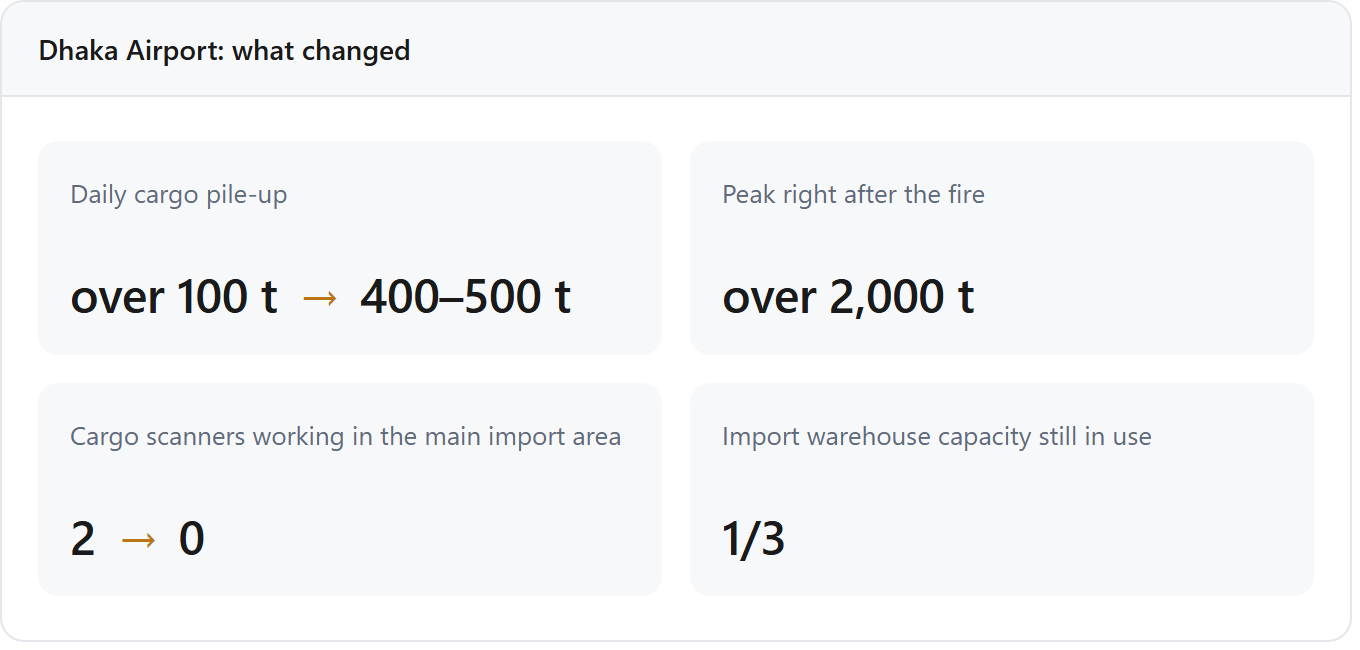
On 18 October 2025, a fire broke out in the Cargo Village at Dhaka Airport (reported by bdnews24, 18 October 2025). It put the cargo scanners in the main import area out of action. Before the fire there were two, and one of them was already faulty. They were not replaced. With the scanners gone, customs has relied more heavily on document verification, and on physical inspection where a consignment looks suspicious. That is not the same as every consignment being opened by hand. Officials at Dhaka Customs House put it plainly: around 80 per cent of consignments still leave the warehouse within a day (The Business Standard, 20 September 2026).
The result: the daily pile-up rose from more than 100 tonnes before the fire to around 400–500 tonnes. In the immediate aftermath it passed 2,000 tonnes. The import warehouse now runs at about one third of its capacity. Some cargo sits outside in the open, under sun and rain. The figures are set out in The Business Standard, 20 September 2026.
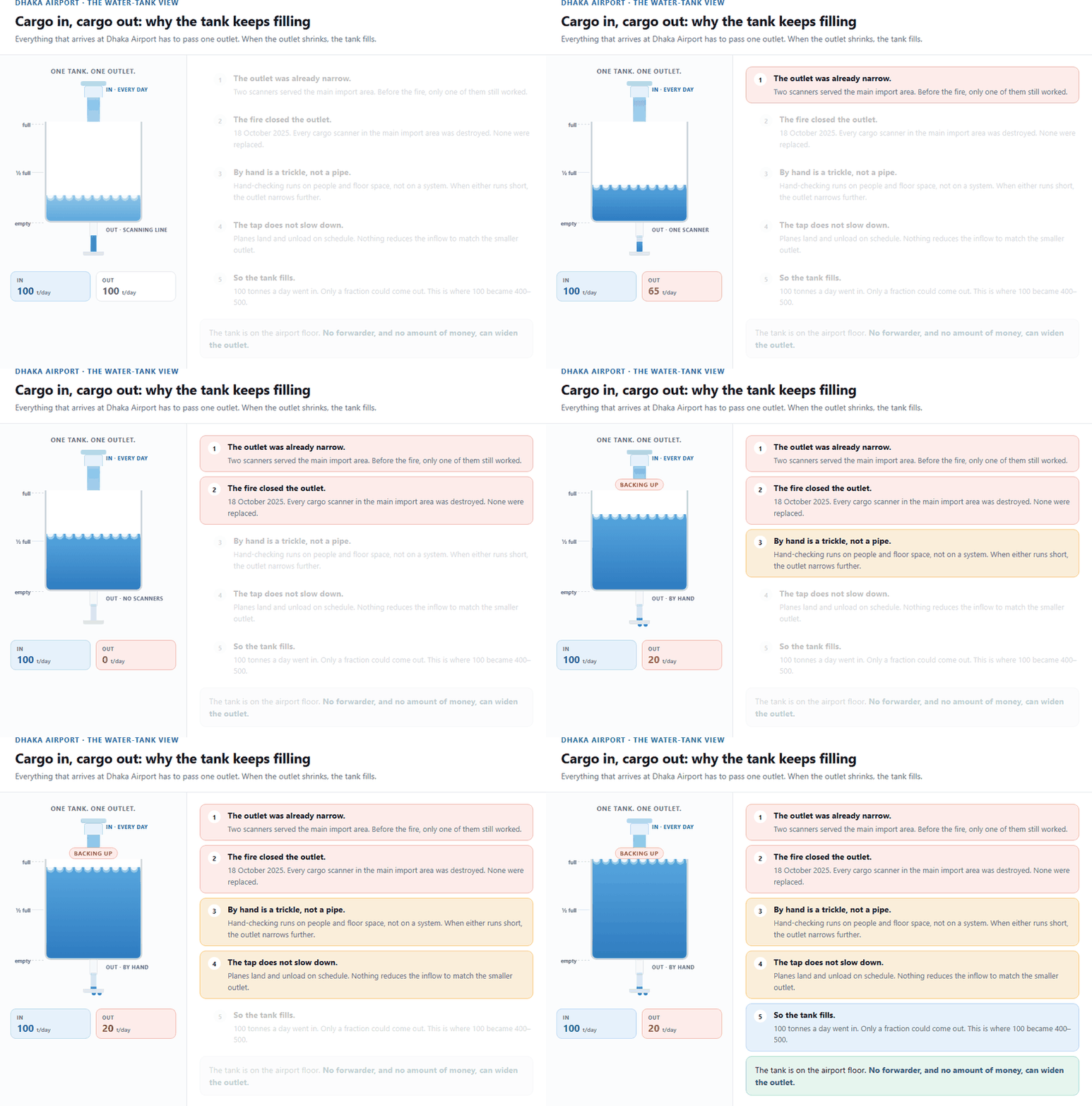
Planes keep landing and unloading as normal. The cargo still cannot get out, so it piles up. No single freight forwarder can solve this. Your cargo is in the same queue as everyone else’s.
1. Why it takes so long
There is one set of equipment, and no backup. The main import area had only two scanners, and one was already faulty. After the fire, neither was available. So clearance now leans on document checks and on physical inspection where a consignment looks suspicious — work that depends on how many people and how much space there is, not on a system. When the queue is long, the cargo stops moving.
The system was already full. Even before the fire, more than 100 tonnes a day were piling up. That tells you there was no spare room. Losing the one scanner that worked made it collapse.
Customs does not work 24 hours. The airport runs around the clock, but customs work drops sharply on Fridays, Saturdays and public holidays, because importers and clearing agents are not at work. Cargo that lands at the weekend simply waits for the next working day.
More cargo is being pushed into the same narrow opening. Bangladesh is short of energy. Factory output has fallen by 30 to 40 percent. Deadlines cannot be met, so goods that used to go by sea are now flying. Demand is rising while handling capacity is falling.
The airport’s executive director has publicly called for customs to clear all unclaimed cargo within seven days, and for a law to auction goods that sit longer. New scanners are expected in December 2026. A third terminal is planned to raise yearly cargo capacity from 200,000 tonnes to 546,000 tonnes. That is still a long way off.
One thing worth putting in context: there was a second fire at the Cargo Village on the night of 5 June 2026. It started at a container in the courier operation area. Two firefighting units had it under control within 14 minutes, and flight operations were not affected (The Business Standard; UNB). The damage described above still traces back to the October 2025 fire, not to that night. The cause of the June fire was not established, and it did not undo any of the recovery work.
2. Where exactly it gets stuck
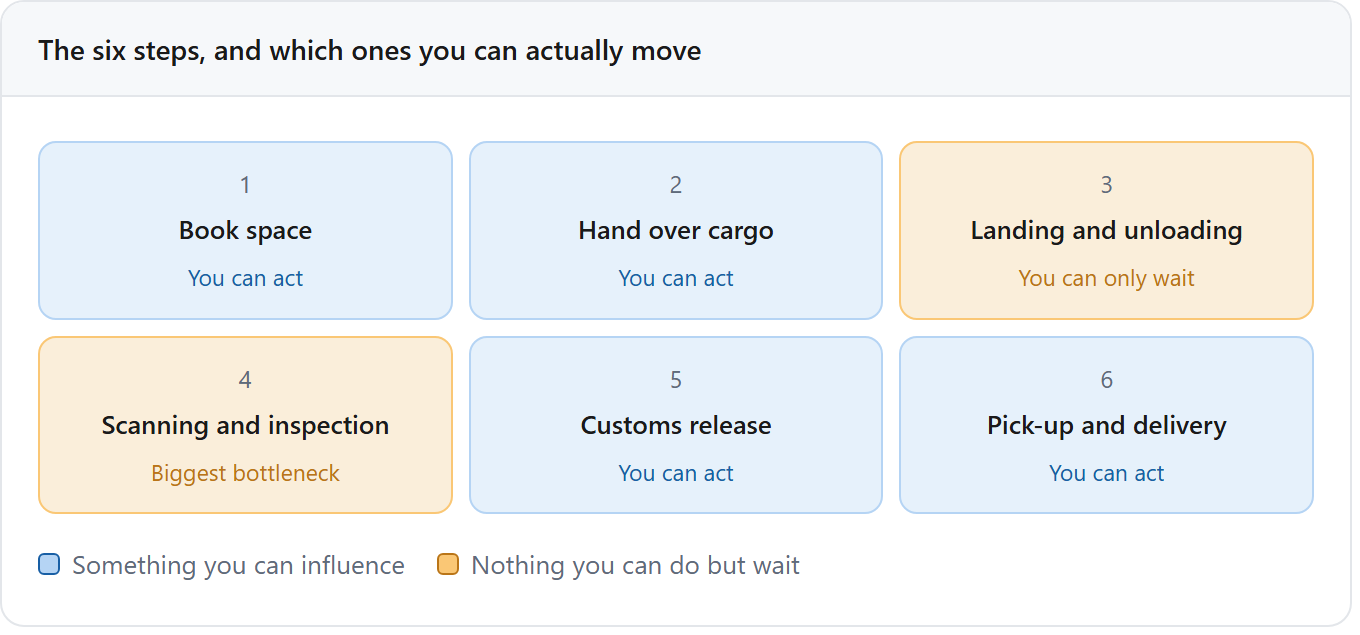
“Stuck” is too general a word. In practice, cargo gets stuck at one of six points, and each one needs a different response.
| Step | Who controls it | What you can do |
|---|---|---|
| 1 Booking & space | Airline, origin handling agent | Book early; allow more time in peak season; keep a second departure airport ready |
| 2 Handover at origin | Origin forwarder, warehouse | Confirm handover and cut-off times; prepare documents early |
| 3 Landing & unloading | Airport ground handler | Almost nothing. You can only wait |
| 4 Scanning & inspection | Airport, customs | Today’s biggest bottleneck. With no scanners in the main import area, timing depends on manual checks and is hard to predict |
| 5 Customs release | Customs, clearing agent | Accurate documents, duty ready in advance, an agent who answers quickly |
| 6 Pick-up & transport | Warehouse, transport provider | Book trucks early; avoid weekends and holidays |
To find out where your cargo really is, ask your handler four questions:
- Which step is it at?
- When was the last action completed?
- What is the next action?
- What is it waiting for?
If the reply you get is simply “it’s at the airport”, that is not an answer. It is just repeating what you already know.
3. What you can still do
Five things you can act on, from what you control most to what you control least. Print this and tick them off.
Before you ship
- Check every document, item by item.Paperwork is the most common cause of customs delay, and it is the one thing you control completely.
- Put Fridays, Saturdays and Bangladeshi public holidays into your schedule.Customs work drops sharply on those days. Cargo that lands then simply waits for the next working day.
- Pick a clearing agent who answers fast, not one who only quotes low.Once the cargo is on the ground, how quickly someone responds matters more than how little they charge.
When you book
- For urgent cargo, confirm the departure airport and the space in advance.We can arrange air service out of Shanghai, Hangzhou, Guangzhou, Kunming and Hong Kong, China. Which one is used is confirmed per shipment.
When you ask for an update
- Do not ask “how much longer?” Ask “which step is it at now?”The first question has no answer while the cargo is on the ground. The second one does.
4. What not to expect
An express fee buys you space on a plane. It does not buy capacity on the ground. No amount of money will produce the scanners Dhaka Airport does not have.
If the problem is at the origin, changing forwarder helps. If the problem is on the ground in Dhaka, changing forwarder changes nothing.
Nobody can tell you exactly how many days your cargo will take. Half of what decides the timing is not in any forwarder’s hands. So do not judge a forwarder by whether they promise you a delivery date. Judge them by whether they can tell you where your cargo is right now, any time you ask.
Sources: The Business Standard, 20 September 2026, on the cargo backlog, the scanner shortage and how consignments are inspected; The Business Standard and UNB, on the fire of 5 June 2026; bdnews24, 18 October 2025, on the fire of 18 October 2025. Conditions at the airport may have changed since. Last checked 8 October 2026.